

How Do I Cite To Illinois Register Alwd
I. C.F.R. Versus e-CFR and its Progeny?
A. The Historic Print-Determined Timeline
Federal regulations pose the same key citation question every bit do provisions in the United states Code. On January 18, 2017, important new and amended regulations governing the determination of disability benefit claims nether the Inability Insurance and Supplemental Security Income programs were published in the Federal Register.
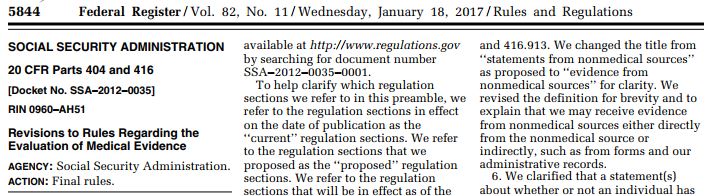
Jan 18, 2017
The changes took result on March 27. The Federal Register for that very date contained a series of "technical amendments" cleaning upwards minor drafting errors in the January version of the text. Those corrections arrived but in time to beat the April 1st cutoff appointment for the volume of the 2017 print edition of the Lawmaking of Federal Regulations that contains Function 404 of Championship 20. That is where the regulations governing these programs are organized. (The Lawmaking'due south annual editions are published in four waves: "[T]itles one-16 are revised as of January ane; titles 17-27 are revised as of April 1; titles 28-41 are revised as of July ane; and titles 42-50 are revised as of October i.")
In due course the volume containing all Social Security Administration regulations, as of April 1, 2017, was published by the Office of the Federal Register of the National Archives and Records Administration. In that concrete form the new regulations, fully compiled and in context, fabricated their way to Federal Depository Libraries, arriving in mid-September.
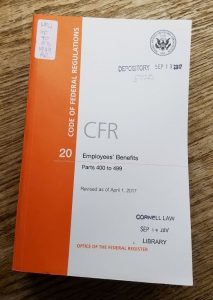
Engagement of Arrival: September 13, 2017
Post-obit distribution of the printed book, a digital replica in PDF was placed online as role of the Government Publishing Office's Federal Digital System (FDsys).
The commendation issue posed past that schedule is this: During the eight months that separated initial publication of these regulations from their appearance in a volume of the "official" Code of Federal Regulations (impress and electronic) would it accept been appropriate to cite them in accordance with the code location designations they carried from the moment of release? Take the revised 20 C.F.R. § 404.1521, for example. The pre-2017 version of that section dated from 1985. How should a legal memorandum written and filed in July 2017 have cited the text of the department by then in upshot?
Citation norms, formed during the era in which the printed volumes of the Code of Federal Regulations and its companion, the Federal Annals, were the simply trustworthy means of accessing federal regulatory texts, would crave citing such a recently revised provision to the Federal Register effect dated Jan 18, 2017, until the C.F.R. book holding it could be inspected.
B. east-CFR and Derivative Compilations
Today the aforementioned public offices that publish the official Code of Federal Regulations also prepare and disseminate online a continuously updated version of the Code they call the "Electronic Lawmaking of Federal Regulations" or eastward-CFR. Information technology lags the nearly recently published final regulations past a few days, at most.

On December 8, for instance, all sections of the e-CFR were electric current as of December 6. As is truthful with the Office of Law Revision Counsel'south online version of the United States Code, the east-CFR can be downloaded in majority (in XML). That makes it possible for all major online legal information services to offer comparably up-to-date versions of the C.F.R. In short, in the current research environment, the lawyer, judge, or legal scholar who would read, quote, and cite to provisions of the Code of Federal Regulations as they stand at the moment of writing has no alibi non to describe upon the e-CFR or one of its reliable derivatives. (The latter include up-to-date versions of the C.F.R. maintained past Bloomberg Law, Lexis, Westlaw, and Cornell's Legal Information Found (LII).)
II. Chronological Version as Distinguished from Source
A. Disambiguating Recently Altered Provisions
Unless the citation to a compilation like the Lawmaking of Federal Regulations or the U.s. Lawmaking indicates otherwise, it volition be understood as pointing to the cited portion as it stood at the time of writing. Contempo regulatory (or statutory) changes to a provision are likely to require a parenthetical notation to remove doubtfulness about the reference. With a commendation to twenty C.F.R. § 404.1521, for example, the reader will desire to know whether the writer is invoking the department'southward linguistic communication before or after the 2017 revision. The writer may well also want to point to the reader that she is aware of the modify. On this score an initial commendation reading "20 C.F.R. § 404.1521 (as amended in 2017)" or fifty-fifty "20 C.F.R. § 404.1521 (as amended, 82 Fed. Reg 5844, 5868 (January. 18, 2017))" is more useful than 1 that only furnishes the yr of the well-nigh contempo official publication or the "as of" engagement of an unofficial version. On the other manus, a citation to 20 C.F.R. § 404.130, which was final amended in 1990, need carry no such baggage.
The existence of the chronological slices represented past the annual official versions does provide a ready means for citing to provisions as they one time read. So long as the context makes it articulate that the writer means to refer to the linguistic communication of the section every bit it stood before the recent modify, a citation reading "20 C.F.R. § 404.1521 (2016)" should suffice. But standing alone, ane reading "20 C.F.R. § 404.1521 (prior to the Jan. xviii, 2017 amendment)" provides a reader with more information. The GPO'due south online archive of past C.F.R. editions, which reaches back to 1996, allows retrieval of no-longer-current regulatory texts on the footing of such references.
B. The Citation Manuals' Requirement of a Date Element in All Cases
Rule fourteen.two(a) of The Bluebook calls for a C.F.R. citation to include the year of the cited section's "almost recent edition." No exceptions. The mandate applies to a provision like twenty C.F.R. § 404.130 which has not been amended for over a quarter century. For a citation in a memorandum completed in July 2017, this dominion would require "20 C.F.R. § 404.130 (2016)". A few months afterward, that, again per The Bluebook, would go "20 C.F.R. § 404.130 (2017)". The Indigo Book, being limited in purpose to prying the citation organization codified in The Bluebook out of its proprietary wrapper, takes precisely the same position. The ALWD Guide to Legal Commendation (sixth ed.) goes a pace further and addresses the likelihood that the writer has relied on an online compilation more than upward-to-appointment than the once-a-twelvemonth official edition. Acknowledging the e-CFR, it provides in Dominion xviii.i(c), that if one is relying on its version of the C.F.R. the commendation should "point the exact date (Month Twenty-four hours, Twelvemonth) through which the provision is current, and append its URL after the publication parenthetical." If the author has, instead, referred to a commercial service's compilation, ALWD calls for the citation to accept the grade: "27 C.F.R. § 72.21 (Westlaw through Sept. 29, 2016)". (The section in its case was last amended in 1995.) In the ordinary case, both are unnecessary.
C. How Federal Judges (and Lawyers Appearing before them) Cite the C.F.R.
With the exception of opinions of the U.S. Supreme Court exercise which include the year of the current volume in initial citations to the Lawmaking of Federal Regulations, the decisions of about federal judges cite its provisions generically. That is, so long as they are referring is to the linguistic communication of a C.F.R. section currently in effect, they cite it without any indication of date or online source. Run into, for example, the citations in:Gorman v. Berryhill, No. iii:16-CV-05113 (W.D. Mo., Nov. 30, 2017);Trevizo v. Berryhill, 862 F. 3d 987 (9th Cir. 2017); andCazun five. Attorney Gen., 856 F.3d 249 (3d Cir. 2017). Briefs filed past the U.Due south. Justice Department take the same approach.
D. The Publication Lag and Hoped-For Useful Life of Periodical Articles May Legitimately Call for The Bluebook's or ALWD Guide's Approach
Generally, months pass between an author's completion of a journal article and its eventual publication. Moreover, since publication delays are common, the date carried by the journal issue in which the commodity appears may or may not correspond to the bodily date of its distribution. Finally, against the odds, the author may imagine the piece being read with care for years into the future. Arguably, these factors argue for attachment of an explicit statement of the "current every bit of date" to all cited statutory and regulatory code sections. At minimum their inclusion reminds an unknown, and perhaps afar, reader to bank check on whether subsequent amendments may have altered the force of the writer'due south analysis.
In contrast, legal briefs and judicial opinions carry explicit dates of filing. So long as there is no indication to the opposite, those reasonably anchor an assumption that all citations to codified statutes and regulations they contain refer to the provisions in upshot on that date.
Tags: ALWD, Bluebook, codes, regulations

How Do I Cite To Illinois Register Alwd,
Source: https://citeblog.access-to-law.com/?p=970
Posted by: gilbertgratting.blogspot.com
0 Response to "How Do I Cite To Illinois Register Alwd"
Post a Comment