

What Cryptocurreny Exchanges Are Registered With The Sec
Equally cryptocurrencies spread across the earth, then besides do the regulations put in place to govern them. The crypto landscape is constantly evolving and keeping up to date with the rules in dissimilar global territories isn't like shooting fish in a barrel.
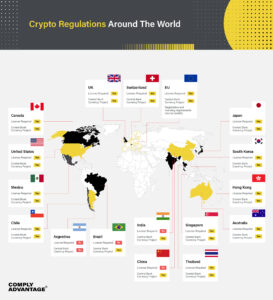
To assist you navigate the array of global legislative attitudes towards cryptocurrencies, and the activities associated with them, we've put together this guide. Larn how different nations arroyo coin and substitution regulation and if they have any upcoming legislation which could alter their approach to cryptocurrencies.
The content in this article was terminal updated in February 2022.
United States
Cryptocurrencies: Not considered legal tender
Cryptocurrency exchanges: Legal, regulation varies by state
While information technology is difficult to observe a consistent legal approach at the state level, the Usa continues to progress in developing federal cryptocurrency legislation. The Financial Crimes Enforcement Network (FinCEN) does not consider cryptocurrencies to be legal tender only considers cryptocurrency exchanges to be money transmitters on the basis that cryptocurrency tokens are "other value that substitutes for currency." The Internal Revenue Service (IRS) does not consider cryptocurrency to be legal tender but defines it as "a digital representation of value that functions as a medium of substitution, a unit of business relationship, and/or a store of value" and has issued revenue enhancement guidance accordingly.
Exchanges
Cryptocurrency exchanges are legal in the United states of america and fall nether the regulatory scope of the Banking concern Secrecy Human activity (BSA). In do, this means that cryptocurrency exchange service providers must register with FinCEN, implement an AML/CFT program, maintain appropriate records, and submit reports to the authorities. Meanwhile, the US Securities and Exchange Commission (SEC) has indicated that it considers cryptocurrencies to be securities, and applies securities laws comprehensively to digital wallets and exchanges. Past contrast, The Commodities Futures Trading Commission (CFTC) has adopted a friendlier, "do no harm" approach, describing Bitcoin as a commodity and allowing cryptocurrency derivatives to trade publicly.
In response to guidelines published by FATF in June 2019, FINCEN made clear that it expects crypto exchanges to comply with the "Travel Rule" and gather and share information most the originators and beneficiaries of cryptocurrency transactions. Information technology places virtual currency exchanges in the same regulatory category as traditional money transmitters and applies nevertheless regulations, including those set out in the Bank Secrecy Act – which has established its ain version of the Travel Rule. In October 2020, FINCEN released a Notice of Proposed Rulemaking (NPRM) on adjustments to the Travel Rule, signaling the introduction of new compliance responsibilities for cryptocurrency exchanges.
Future Regulation
The US Treasury has emphasized an urgent demand for crypto regulations to gainsay global and domestic criminal activities. In December 2020, FINCEN proposed a new cryptocurrency regulation to impose data collection requirements on cryptocurrency exchanges and wallets. The rule is expected to be implemented past Fall 2022, and would require exchanges to submit suspicious activity reports (SAR) for transactions over $10,000 and require wallet owners to place themselves when sending more than than $3,000 in a single transaction.
The Justice Department continues to coordinate with the SEC and CFTC over future cryptocurrency regulations to ensure effective consumer protection and more streamlined regulatory oversight. In 2021, the Biden administration turned its attention to stablecoins, with the intention to address the danger of the tokens' growth in value. Later that year, the President's Working Group on Fiscal Markets released a serial of recommendations which included a need for new legislation. Congress also debated the status of cryptocurrency service providers in 2021, with new rules included in the Biden administration's infrastructure bill. Under the new rules, cryptocurrency exchanges are regarded equally brokers and must comply with the relevant AML/CFT reporting and tape-keeping obligations.
Enjoyed this episode? Subscribe to the podcast on Apple Podcasts or Spotify, and receive every new episode every bit soon as it launches.
Canada
Cryptocurrencies: Non legal tender
Cryptocurrency exchanges: Legal, required to annals with FinTRAC after June one, 2020
Cryptocurrencies are non legal tender in Canada just can be used to buy goods and services online or in stores that take them. Canada has been fairly proactive in its treatment of cryptocurrencies, primarily regulating them under provincial securities laws. Canada brought entities dealing in virtual currencies nether the Proceeds of Crime (Money Laundering) and Terrorist Financing Act (PCMLTFA) every bit early on as 2014, while in 2017 the British Columbia Securities Commission registered the first cryptocurrency-just investment fund. In Baronial 2017, the Canadian Securities Administrators (CSA) issued a notice on the applicability of existing securities laws to cryptocurrencies, and in Jan 2018, the head of Canada'southward Fundamental Bank characterized them "technically" as securities. The Canada Revenue Bureau has taxed cryptocurrencies since 2013 and Canadian tax laws apply to cryptocurrency transactions.
Exchanges
Afterward an amendment to the PCMLTFA in 2019, exchanges in Canada are substantially regulated in the same way as money services businesses and are subject area to the aforementioned due diligence and reporting obligations. In February 2020, the Virtual Currency Travel Rule came into effect in Canada, requiring all financial institutions and money services businesses (MSB) to keep a record of all cross-edge cryptocurrency transactions (forth with all electronic fund transfers).
In 2021, the Canadian Securities Administrators (CSA) published guidance for crypto issuers that own or concur crypto assets. The guidance set up out regulatory expectations for disclosures that crypto issuers must provide nearly how they protect their assets confronting loss and theft, including the demand to disclose relevant risk factors. Similarly, further amendments to the PCMLTFA in 2021 introduced the requirement for cryptocurrency exchanges to register with the Financial Transactions and Reports Analysis Heart of Canada (FinTRAC).
Future Regulation
While regulations are constantly evolving, there are no signs of significant boosted legislation on the horizon. We suspect both the Canadian government and crypto exchanges will need time to evaluate how the most recent changes have affected the crypto landscape before considering boosted legislation.
Singapore
Cryptocurrencies: Not legal tender
Cryptocurrency exchanges: Legal, registration with the Monetary Authority of Singapore required
In Singapore, cryptocurrency exchanges and trading are legal, and the city-land has taken a friendlier position on the issue than some of its regional neighbors. Although cryptocurrencies are not considered a legal tender, Singapore'due south tax authority treats Bitcoins as "appurtenances" and so applies Goods and Services Revenue enhancement (Singapore'due south version of Value Added Tax). In 2017, the Monetary Potency of Singapore (MAS) clarified that, while its position was not to regulate virtual currencies, it would regulate the consequence of digital tokens if those tokens were classified every bit "securities".
Although information technology has taken an even-handed approach, in 2020 MAS issued warnings to the public of the risks of investing in cryptocurrency products. In 2022, MAS reinforced that alarm, issuing guidelines to crypto service providers that effectively prohibited the advertisement of their services to the public.
Exchanges
MAS has generally taken an accommodating arroyo to cryptocurrency exchange regulation, applying existing legal frameworks where possible. In January 2018, MAS issued a press release warning the public of the risks of speculating with cryptocurrency while Deputy Prime Minister Tharman Shanmugaratnam stated that cryptocurrencies are subject field to the same AML and CFT measures as traditional, fiat currencies. The Payment Services Human activity 2019 (PSA) brought exchanges and other cryptocurrency businesses under the regulatory authority of MAS from Jan 2020, and imposed a requirement for them to obtain a MAS operating license. Since then, MAS has issued licenses to a number of loftier profile crypto service providers, including DBS Vickers (DBS Banking company's brokerage arm) and the Australian crypto commutation, Independent Reserve.
Futurity Regulations
With the PSA in event, crypto businesses in Singapore are largely in alignment with FATF's well-nigh recent recommendations. However, MAS is likely to follow up with additional regulations in an endeavour to further align its position. These regulations may include new financial sector regulations with stronger AML/CFT standards for cryptocurrency service providers, and higher engineering take a chance management reqreuiments in financial institutions.
Singapore's contempo regulatory efforts reflect a renewed international involvement in its crypto industry. In 2021, Cathay's crackdown on cryptocurrencies prompted many high contour Chinese service providers, including ByBit, Huobi, Cobo, and OKCoin, and their customers, to drift to Singapore.
Commonwealth of australia
Cryptocurrencies: Legal, treated as holding
Cryptocurrency exchanges: Legal, must register with AUSTRAC
Cryptocurrencies and exchanges are legal in Australia, and the country has been progressive in its implementation of cryptocurrency regulations. In 2017, Commonwealth of australia's government alleged that cryptocurrencies were legal and specifically stated that Bitcoin (and cryptocurrencies that shared its characteristics) should exist treated as property and subject to Capital Gains Tax (CGT). Cryptocurrencies had previously been subject to controversial double tax nether Australia'due south goods and services tax (GST) – the change in tax treatment is indicative of the Australian government'due south progressive arroyo to the crypto issue.
Exchanges
Since 2018, the Australian Transaction Reports and Analysis Centre (AUSTRAC) has required exchanges operating in Commonwealth of australia to register, place and verify users, maintain records, and comply with government AML/CFT reporting obligations. Unregistered exchanges are subject to criminal charges and financial penalties.
In May 2019, the Australian Securities and Investments Commission (ASIC) issued updated regulatory requirements for both initial money offerings (ICOs) and cryptocurrency trading. Similarly, in August 2020, Australian regulators forced many exchanges to delist privacy coins, a specific blazon of anonymous cryptocurrency.
Futurity Regulations
Australia has established a blueprint of proactive cryptocurrency regulation, and these latest regulations illustrate the land's connected attempt to provide a clear framework for crypto businesses to operate in the coming years.
In item, the Australian government is moving to increase its regulation of cryptocurrency exchanges. In December 2021, Commonwealth of australia appear plans to introduce a new licensing framework specifically for cryptocurrency exchanges – with a consultation flow scheduled for 2022. The proposed framework would enable consumers to safely buy and sell crypto assets in a regulated environs, and represents a move to position Commonwealth of australia at the forefront of the global effort to go along tech companies in check.
Nihon
Cryptocurrencies: Legal, treated as property
Cryptocurrency Exchanges: Legal, must annals with the Financial Services Agency
Japan currently has the world's virtually progressive regulatory climate for cryptocurrencies and recognizes Bitcoin and other digital currencies every bit legal holding nether the Payment Services Human action (PSA). In Dec 2017, the National Tax Agency ruled that gains on cryptocurrencies should be categorized as 'miscellaneous income' and investors taxed accordingly.
Recent regulations include amendments to the PSA and to the Financial Instruments and Exchange Act (FIEA), which took effect in May 2020. The amendments introduced the term "crypto-asset" (instead of "virtual currency"), placed greater restrictions on managing users' virtual money, and eased regulation on crypto derivatives trading. Nether the new rules, cryptocurrency custody service providers (that do not sell or purchase crypto assets) are brought under the telescopic of the PSA while cryptocurrency derivatives businesses are brought under the telescopic of the FIEA.
Exchanges
Cryptocurrency exchange regulations in Japan are similarly progressive. Exchanges are legal in Japan, but after a serial of high profile hacks, including the notorious Coincheck heist of $530 million in digital currency, crypto regulations have become an urgent national concern. Japan's Financial Services Agency (FSA) has stepped up efforts to regulate trading and exchanges: amendments to the PSA crave cryptocurrency exchanges to be registered with the FSA in order to operate – a process which tin take upward to six months, and which imposes stricter AML/CFT and cybersecurity requirements. A subsequent amendment in mid-2019 extended the registration requirement to include custodian services providers.
In 2020, Nihon established the Japanese Virtual Currency Commutation Clan (JVCEA) and the Japan STO Association. All exchanges are members of the JVCEA while the Japan STO Association comprises 5 major Japanese financial institutions. Both regulators work to provide advice to every bit-yet unlicensed exchanges and promote compliance.
Future Regulations
Japan remains a friendly surround for cryptocurrencies only growing AML concerns are cartoon the FSA's attention towards farther regulation. In Dec 2021, the FSA indicated that it would propose legislation in 2022 to regulate issuers of stablecoins in order to address risks to customers and limit opportunities to use stablecoin tokens for money laundering. The legislation volition likely include new security protocols and new obligations for crypto service providers to report suspicious action.
South Korea
Cryptocurrencies: Non legal tender
Cryptocurrency Exchanges: Legal, must register with FSS
In South Korea, cryptocurrencies are not considered legal tender and exchanges, while legal, are part of a closely-monitored regulatory arrangement. Cryptocurrency tax in Due south Korea is a grayness area: since they are considered neither currency nor financial nugget, cryptocurrency transactions are currently tax-free. However, the Ministry of Strategy and Finance has indicated that it is considering imposing a tax on income from crypto transactions and is planning to announce a taxation framework in 2022.
Exchanges
Cryptocurrency exchange regulations in South Korea are strict and involve authorities registration and other measures overseen by the South Korean Financial Supervisory Service (FSS). Although a rumored ban never materialized, in 2017 the South Korean government prohibited the use of anonymous accounts in cryptocurrency trading and banned local financial institutes from hosting trades of Bitcoin futures. Similarly, the Financial Services Commission (FSC) imposes strict reporting obligations on banks with accounts held by crypto exchanges.
Following legislative amendments in 2020, all S Korean exchanges must comply with AML/CFT regulations and obtain an operating license from the Fiscal Services Committee'southward Financial Intelligence Unit of measurement (FIU). In March 2021, the Due south Korean government introduced legislation which requires cryptocurrency investors to employ the same name on their virtual wallet accounts every bit they exercise on their bank accounts – and which requires cryptocurrency exchanges to share data with banks to verify customer identities. The FIU likewise delisted all privacy coins from Due south Korean exchanges in 2021 (effectively banning merchandise of the tokens).
Futurity Regulations
Republic of korea'south proposed taxation on cryptocurrencies missed its original implementation date of January 2022 and has been delayed until Jan 2023. In addition to the revenue enhancement framework, Due south Korea has indicated that it will continue to work to bring the industry into alignment with FATF's anti-coin laundering policies.
Explore our solutions for crypto businesses
Cathay
Cryptocurrencies: Not legal tender
Cryptocurrency exchanges: Illegal
The People's Bank of China (PBOC) banned financial institutions from treatment Bitcoin transactions in 2013 and went further by banning ICOs and domestic cryptocurrency exchanges in 2017. Unsurprisingly, Cathay does non consider cryptocurrencies to exist legal tender and the country has a global reputation for harsh cryptocurrency regulation. Under a 2020 amendment to Communist china's Civil Code, the government ruled that cryptocurrencies have the status of property for the purposes of determining inheritances.
Exchanges
In June 2021, China banned all domestic cryptocurrency mining, and followed-up by outlawing cryptocurrencies outright in September 2021. The new regulation effectively banned the use of all cryptocurrency exchanges (strange and domestic) and prompted a major token sell-off. Although domestic cryptocurrency exchanges are under a coating ban in China, workarounds are possible using certain foreign platforms and websites that Red china's cyberspace firewall doesn't take hold of.
Future Regulations
There's no indication that People's republic of china intends to lift or loosen its ban on cryptocurrencies anytime soon simply recent statements by government officials endorsing blockchain technology have led to speculation that Cathay intends to become a leader in the digital currency space. While a timeline is even so undefined, China's fundamental bank has been working on introducing an official digital currency for years and, in September 2021, announced that it had completed airplane pilot tests of its e-CNY digital currency in several cities. The eastward-CNY token has been developed to supervene upon cash and coins and volition be accustomed as payment for goods, bills, transport fares, and tolls.
Bharat
Cryptocurrencies: Non legal tender
Cryptocurrency exchanges: Regulations being considered
Cryptocurrencies are not legal tender in Republic of india and the status of exchanges remains murky, as new regulations are existence considered. Although there is currently a lack of clarity over the revenue enhancement status of cryptocurrencies, finance minister Bhagwat Karad indicated in February 2022 that cryptocurrency transactions could face up a 30 percent tax.
Commutation Regulations
Cryptocurrency exchange regulations in India have grown increasingly strict. In 2018 the Reserve Bank of India (RBI) banned banks and any regulated financial institutions from "dealing with or settling virtual currencies." The sweeping regulation prohibited the trade of cryptocurrencies on domestic exchanges and forced existing exchanges to current of air down. In 2020, however, in a landmark decision, the country'southward Supreme Court ruled that ban unconstitutional and relented, assuasive exchanges to reopen.
Future Regulations
In 2019, a leaked, alleged draft bill suggested that a blanket ban of cryptocurrencies was in the works – but fabricated an exception for a proposed official digital currency. The bill even suggested prison house sentences for individuals who "mine, generate, hold, sell, deal in, issue, transfer, dispose of, or utilize cryptocurrency in the territory of India."
Although that typhoon bill did not make information technology to the flooring of parliament, in 2021 a study from the Chairmanship of Secretarial assistant (Economic Diplomacy) revived the legislative push to prohibit "all individual cryptocurrencies, except any virtual currencies issued by the state." The Indian Minister of Country for Finance suggested that a new cryptocurrency bill – known equally the Cryptocurrency and Regulation of Official Digital Currency Bill – would be forthcoming. While the Indian government has made its opposition to private cryptocurrencies clear, in November 2021, the Continuing Committee on Finance met with representatives of crypto exchanges and ended that cryptocurrencies should be regulated rather than banned. As of February 2022, the cryptocurrency pecker has not been canonical by Lok Sabha, India's parliament, meaning the legislative status of cryptocurrencies in the country remains unclear.
United kingdom
Cryptocurrencies: Non legal tender
Cryptocurrency exchanges: Legal, registration requirements with FCA
The Britain'south arroyo to cryptocurrency regulations has been measured. Although the Uk has no specific cryptocurrency laws, cryptocurrencies are non considered legal tender and exchanges have registration requirements. HMRC has issued a brief on the tax treatment of cryptocurrencies, stating that their 'unique identity' means they can't exist compared to conventional investments or payments, and their 'taxability' depends on the activities and parties involved. Gains or losses on cryptocurrencies are, however, subject field to upper-case letter gains tax.
Exchanges
Afterward leaving the EU in 2020, the Uk transposed the cryptocurrency regulation requirements set out in 5AMLD and 6AMLD into domestic law. Appropriately, cryptocurrency exchanges in the United kingdom of great britain and northern ireland need to register with the Fiscal Acquit Potency (FCA) and comply with AML/CFT reporting obligations. While it doesn't brand special provisions for exchanges, FCA guidance stresses that entities engaging in activities involving cryptoassets must comply with the Money Laundering, Terrorist Financing and Transfer of Funds (Information on the Payer) Regulations 2017 (MLRs). Amendments to those regulations came into force in January 2020 and incorporate the latest FATF guidelines.
Future Regulations
It is likely that the Uk'due south cryptocurrency regulations volition remain largely consistent with the EU in the short term but diverge from the bloc to some degree in the future. In 2021, HM Treasury guidance emphasized the United kingdom of great britain and northern ireland's intention to consult on bringing sure cryptocurrencies under the telescopic of 'financial promotions regulation' and to keep to consider a 'broader regulatory arroyo' to crypto assets. In Jan 2022, the government appear plans for legislation to accost 'misleading cryptoasset promotions' with the intention to bring cryptocurrency averts 'into line with other financial advertising'.
Switzerland
Cryptocurrencies: Legal, accepted as payment in some contexts
Cryptocurrency exchanges: Legal, regulated by SFTA
In Switzerland, cryptocurrencies and exchanges are legal and the country has adopted a remarkably progressive stance towards cryptocurrency regulations. The Swiss Federal Tax Assistants (SFTA) considers cryptocurrencies to be assets: they are subject to the Swiss wealth taxation and must be declared on annual tax returns.
Exchanges
Switzerland imposes a registration process on cryptocurrency exchanges, which must obtain a license from the Swiss Financial Market Supervisory Authorisation (FINMA) in order to operate. Cryptocurrency regulations in Switzerland are also in identify for ICOs, and FINMA applies existing financial legislation to offerings in a range of fields – from banking, to securities trading and collective investment schemes (depending on the structure). In 2019, Switzerland's government also approved a motion that directed the Federal Council to suit existing financial regulatory provisions to include cryptocurrencies. In September 2020, Switzerland'due south parliament passed the Blockchain Act, farther defining the legalities of exchanging cryptocurrencies and running cryptocurrency exchanges, in Swiss Law.
In 2021, Switzerland introduced the Distributed Ledger Engineering science (DLT) Act with the goal of adjusting Swiss laws to take reward of cryptocurrency innovation. The DLT Act included a new type of license category for cryptocurrency trading venues.
Future Regulations
Switzerland's government has indicated that information technology will continue to work towards a regulatory environment that is friendly to cryptocurrencies. In 2016, the boondocks of Zug, a prominent global cryptocurrency hub, introduced Bitcoin equally a fashion of paying city fees while in January 2018, Swiss Economics Minister Johann Schneider-Ammann stated that he was aiming to make Switzerland "the crypto-nation". Similarly, the Swiss Secretary for International Finance, Jörg Gasser, has emphasized the need to promote cryptocurrencies while upholding existing fiscal standards.
Edifice on those objectives, in belatedly 2020, Switzerland's Department of Finance began a consultation on new blanket cryptocurrency regulations that would enable it to have advantage of blockchain technology without stifling innovation. In 2021, the Swiss Federal Quango voted in favor of a proposal to further suit existing financial regulations to cryptocurrencies in order to accost their illegal use.
The Eu
Cryptocurrencies: Legal, member-states may not introduce their own cryptocurrencies
Cryptocurrency exchanges: Regulations vary by fellow member-state
Cryptocurrencies are broadly considered legal beyond the European Union, simply cryptocurrency substitution regulations are different in individual fellow member states. Cryptocurrency taxation likewise varies but many member-states charge majuscule gains taxation on cryptocurrency-derived profits at rates of 0-50%. In 2015, the Court of Justice of the European Union ruled that exchanges of traditional currency for cryptocurrency should be exempt from VAT.
In January 2020, the Eu'southward 5th Anti-Coin Laundering Directive (5AMLD) brought cryptocurrency-fiat currency exchanges nether EU anti-money laundering legislation, requiring exchanges to perform KYC/CDD on customers and fulfill standard reporting requirements. In December 2020, 6AMLD came into effect: the directive made cryptocurrency compliance more stringent by adding cybercrime to the list of money laundering predicate offenses.
Exchanges
Cryptocurrency exchanges are not currently regulated at a regional level. In certain member states, exchanges have to annals with their respective regulators such as Germany'due south Financial Supervisory Authority (BaFin), France'due south Autorité des Marchés Financiers (AMF), or Italy'southward Ministry building of Finance. Authorizations and licenses granted by these regulators tin then passport exchanges, assuasive them to operate under a single regime across the unabridged bloc.
6AMLD also had consequences for cryptocurrency exchanges. Nether the directive, liability for coin laundering offenses is extended to legal persons as well as individuals, meaning that the leadership employees of cryptocurrency wallet providers and cryptocurrency exchanges must exercise much greater oversight of their internal AML controls.
Future Regulations
The EU is actively exploring further cryptocurrency regulations. An EU typhoon certificate expressed concerns near the risks associated with private digital currencies and confirmed that the European Central Bank was considering the possibility of issuing its own digital currency. In January 2020, the European Commission announced a public consultation initiative, seeking guidance on where and how crypto assets fit into the European union's existing regulatory framework. The Commission followed-up in September 2020 with a new proposal known as the Markets in Crypto-Assets Regulation (MICA). The proposal prepare out draft regulatory measures for cryptocurrencies including the introduction of a new licensing system for crypto-nugget issuers, industry bear rules, and new consumer protections.
In July 2021, the European Committee published a set of legislative proposals with consequences for virtual asset service providers (VASP) across the bloc. The proposals will see transfer of fund regulations (TFR) extended to all VASPs in the EU, and will mandate the collection of information almost senders and recipients of cryptocurrency transfers.
Download our guide to the EU'due south new AML/CFT Framework
Malta
Cryptocurrencies: Not legal tender
Cryptocurrency exchanges: Legal, regulated under the VFA Human action
Malta has taken a very progressive approach to cryptocurrencies, positioning itself every bit a global leader in crypto regulation. While cryptocurrencies are not legal tender in Malta, they are recognized by the government as "a medium of exchange, a unit of account, or a store of value." Malta has no specific cryptocurrency tax legislation nor is VAT currently applicable to transactions exchanging fiat currency for crypto.
Exchanges
Cryptocurrency exchanges are legal in Malta and in 2018 the Maltese authorities introduced landmark legislation that defined a new regulatory framework for cryptocurrencies and addressed AML/CFT concerns. The legislation comprised several bills, including the Virtual Financial Assets Act (VFA) which set a global precedent by establishing a regulatory regime applicable to crypto exchanges, ICOs, brokers, wallet providers, directorate, and nugget managers.
The VFA regulations (effective Nov 2018) were accompanied by the Innovative Technology Arrangements and Services Human activity which established the regime for the future registration, and accountability, of crypto service providers. The Malta Digital Innovation Authority was also established: the MDIA is the government authorisation responsible for creating crypto policy, collaborating with other nations and organizations, and enforcing ethical standards for the use of crypto and blockchain engineering science.
Time to come Regulations
No new crypto legislation is currently on the horizon but the Republic of malta Financial Services Authorisation (MFSA) indicated in its strategic plan for 2019-2021 that the land's financial services regulator "will actively monitor and manage business-related risks pertaining to licensed virtual assets and cryptocurrency businesses" in guild to better address money laundering and other financial crime risks.
The Maltese government has also indicated that it will turn its focus to the integration of AI with cryptocurrency regulation and may implement specific guidelines for security token offerings. With those strategies in mind, boosted Maltese regulations are likely in the near futurity.
Estonia
Cryptocurrencies: Not legal tender
Cryptocurrency exchanges: Legal, must register with the Financial Intelligence Unit
Cryptocurrency regulations in Republic of estonia are open and innovative, especially in comparison to other Eu member-states. Estonia's government does not accept cryptocurrencies equally legal tender, but regards them as "value represented in digital form". Accordingly, it classifies them every bit digital avails for tax purposes but does not subject them to VAT. In 2017, the Anti Coin Laundering and Terrorism Finance Act introduced robust new regulations for crypto businesses operating in Estonia.
Exchanges
Cryptocurrency exchanges are legal in Estonia and operate under a well-defined regulatory framework that includes strict reporting and KYC rules. Nether current legislation, cryptocurrency exchanges must obtain two licenses from the Financial Intelligence Unit of Republic of estonia: the Virtual Currency Substitution Service License and the Virtual Currency Wallet Service License. In 2019, the Estonian regime passed legislation tightening licensing requirements and went further in 2020, asserting that virtual currency service providers would be treated the aforementioned manner as fiscal institutions under the Money Laundering and Terrorist Financing Prevention Act. In late 2020, the Estonian government revoked over 1,000 operating licenses after legislative amendments rendered many cryptocurrency service providers not-compliant with regulations.
Future Regulations
A number of crypto initiatives with potentially significant regulatory consequences accept been mooted in Estonia, including a speculative government plan to introduce a national cryptocurrency known as "estcoin". In December 2021, Republic of estonia published a typhoon nib to extend AML/CFT regulations to cryptocurrency exchanges: effectively banning the use of private cryptocurrency wallets provided past VASPs. The draft bill created fears that Estonia was banning individual ownership of cryptocurrencies, and prompted the government to result a press release in January 2022 clarifying that the law would only utilise to private wallets issued past VASPs.
Gibraltar
Cryptocurrencies: Not considered legal tender
Cryptocurrency exchanges: Legal, must register with the GFSC
Gibraltar is a global leader in cryptocurrency regulation. Cryptocurrency is not considered legal tender in the country but cryptocurrency exchanges are legal and operate inside a well-divers regulatory framework. Gibraltar has a reputation equally a low tax surroundings: information technology does not impose majuscule gains or dividend revenue enhancement on cryptocurrencies, and crypto exchanges are subject to a business-friendly 12.5% corporate income tax charge per unit.
Exchanges
In 2018, Gibraltar introduced its Digital Ledger Technology (DLT) Regulatory Framework later on extensive engagement with the crypto industry. Nether the framework, exchanges must register with the Gibraltar Fiscal Services Commission (GFSC) and demonstrate that they are meeting the "principles" of the DLT framework which include a strong focus on the detection and disclosure of coin laundering and terrorist financing. In September 2020, Gibraltar updated its DLT framework regulations to better align with FATF recommendations, taking into account the higher risk factors associated with some virtual nugget instruments.
Time to come Regulations
Gibraltar'southward government is seeking to strengthen its position every bit a global leader by exploring further cryptocurrency regulation. In 2017, the GFSC issued a statement on the unregulated employ of ICOs and suggested it will monitor their ongoing use inside the DLT Framework. Similarly, the commission'south Innovate and Create Squad has been established to help businesses innovate new products for the crypto-economy. In 2021, Gibraltar convened a Market Integrity working group to farther define appropriate market standards for cryptocurrency exchanges in coordination with standards set by other jurisdictions such as the UK and the EU.
The government's attitude to cryptocurrency is attracting interest from investors seeking to have advantage of Gibraltar's progressive regulatory surroundings. In 2022, blockchain firm Valereum announced plans to fix a cryptocurrency stock commutation in the territory, and bought a 90% pale in the Gibraltar Stock Exchange. If sanctioned by the Gibraltar Financial Services Commission, the move would pave the way for a fully-regulated exchange dealing in both fiat and digital currencies.
Luxembourg
Cryptocurrencies: Not legal tender
Cryptocurrency exchanges: Legal, must register with the CSSF
At that place are no specific cryptocurrency regulations in Grand duchy of luxembourg but the authorities's legislative attitude towards cryptocurrencies is more often than not progressive. Although they are not legal tender, Finance Minister Pierre Gramegna has commented that, given their widespread use, cryptocurrencies should be "accepted as a ways of payment for appurtenances and services" in Grand duchy of luxembourg. In 2018, authorities issued advice on the tax treatment of cryptocurrencies which, in a business context, depends on the blazon of transaction involved.
While the Commission de Surveillance du Secteur Financier (CSSF) has issued warnings about the volatility of cryptocurrencies, their vulnerability to offense, and the associated risks of investing in ICOs, Luxembourg'due south progressive approach to crypto has nonetheless endured. The CSSF has best-selling the financial benefits of blockchain engineering science and Pierre Gramegna has spoken of the "added value and efficient services" that cryptocurrencies bring. Post-obit those statements, in early on 2019 lawmakers passed legislation that gave blockchain engineering transactions the same legal condition as those executed using traditional methods.
Exchanges
Cryptocurrency exchanges in Grand duchy of luxembourg are regulated by the CSSF and new crypto businesses must obtain a payments institutions license if they wish to begin trading. The licenses impose AML/CFT reporting obligations nether Luxembourg's "electronic money" statutes: the first crypto license was granted in 2016 to Bitstamp, which trades in a range of currencies, including USD, EUR, Bitcoin, and Ethereum, and passports holders into other Eu fellow member-states. In 2020 amendments were fabricated to Luxembourg's AML/CFT laws introducing new registration and governance requirements for cryptocurrency service providers and setting out a legal definition of cryptocurrencies for regulatory purposes.
Future Regulations
Although there are no specific legislative steps on the radar, we expect more crypto legislation to be forthcoming in Luxembourg particularly now that the EU's 5AMLD and 6AMLD are in effect.
Latin America
Cryptocurrencies: Laws vary by country
Cryptocurrency exchanges: Sparse regulation, laws vary past country
In Latin America, cryptocurrency regulations run the legislative spectrum. Those countries with harsher regulations include Bolivia which has comprehensively banned cryptocurrencies and exchanges, and Ecuador which has issued a ban on the circulation of all cryptocurrencies autonomously from the government-issued SDE token (in operation from 2014 to 2018). By contrast, in Mexico, Argentine republic, Brazil, Venezuela and Chile, cryptocurrencies are normally accepted equally payment by retail outlets and merchants.
For taxation purposes, cryptocurrencies are frequently treated every bit assets. They are broadly subject to upper-case letter gains taxation across the region while transactions in Brazil, Argentine republic, and Republic of chile are also subject area to income tax in some contexts.
In September 2021, Republic of el salvador became the first land in Latin America to make Bitcoin legal tender, issuing a government digital wallet app, and allowing consumers to use the tokens in all transactions (alongside payments with the U.s.a. dollar). The movement prompted foreign and domestic criticism, merely El salvador'south government has since appear plans to build a 'Bitcoin urban center' that will be funded by the token.
Exchanges
Cryptocurrency exchange regulations in Latin America are sparse. Many countries have no specific laws governing the trade of cryptocurrencies and then, beyond the scope of existing legislation, do non regulate exchanges. The lack of regulation combined with loftier adoption rates has made Latin America an attractive option for businesses looking to capitalize on the interest in virtual currencies.
This collective stance has led to friction with the region'southward traditional banking industry and in Chile, for example, some banks took steps to shut accounts held by cryptocurrency exchanges in late 2018. Subsequent court rulings have offered protection to these exchanges for the time being but information technology is clear that more definitive guidelines are needed.
In contrast to other Latin American countries, United mexican states does, to an extent, regulate cryptocurrency exchanges through the Law to Regulate Fiscal Technology Companies. The constabulary extends Mexican AML regulations to cryptocurrency services providers by imposing a diverseness of registration and reporting requirements.
Future Regulations
Many Latin American countries have expressed business concern about the effect of cryptocurrencies on financial stability – and well-nigh their money laundering risks. Beyond issuing official warnings, nonetheless, about fiscal authorities across the region have yet to reveal plans for whatsoever significant futurity cryptocurrency regulations.
Some exceptions have emerged: Chile, for example, introduced draft cryptocurrency legislation in April 2019 but has offered scant particular on the legislation since, or how it will function if information technology comes into effect. In 2022, Republic of chile's central depository financial institution announced that it would make a conclusion on the rollout of its ain digital currency in order to keep footstep with the rapid spread of cryptocurrencies. Mexico has as well announced plans to release its own digital currency by 2024, seeking to take advantage of advances in payment applied science to promote financial inclusion.
In 2020, in coordination with crypto exchanges, Colombia introduced a sandbox test surroundings for cryptocurrencies in order to help firms try out their business organisation models in respect of draft legislation. Brazil's Securities Committee and its Central Bank have too introduced a regulatory sandbox while, in 2021, the Brazilian congress discussed typhoon legislation to impose new tape-keeping regulations on cryptocurrency exchanges.
Want to run across and exceed the expectations of regulators around the world?
Find out how ComplyAdvantage works with crypto businesses here.
Request a Demo
See how 1000+ leading companies are screening against the world's but existent-time risk database of people and businesses.
Request Demo
Originally published July 5, 2018, updated March 10, 2022

Source: https://complyadvantage.com/insights/cryptocurrency-regulations-around-world/
Posted by: gilbertgratting.blogspot.com
0 Response to "What Cryptocurreny Exchanges Are Registered With The Sec"
Post a Comment