

Why Would A Cingular Wireless Tower Not Be Registered?
Airtime Fairness: Reducing Congestion in Wireless Networks
Nothing can exist more annoying than a poor internet experience. If you are nevertheless suffering from deadening Wi-Fi speed, information technology is time to endeavour an amazing characteristic that is deployed on TP-link's wireless routers, Airtime Fairness.
What is Airtime Fairness (ATF)?
Airtime Fairness is an optimization technique used to improve the overall transmission efficiency of a wireless network. "Airtime" here refers to the wireless transmission time a client takes to communicate with a Wireless Access Indicate (AP). With ATF enabled, AP tin can fairly classify the airtime of different clients and prevent low-speed clients from taking upwardly too much bandwidth.
How does Airtime Fairness work?
Before nosotros first to talk about how ATF works, information technology is helpful to know something near wireless networks.
First, wireless manual is ordered. As you may know, wireless signals are transmitted through electromagnetic waves. Still, if unlike clients simultaneously communicate with an AP using the same frequency, information technology causes signal interference. Therefore, wireless networks are designed that only two devices can communicate with each other in the same frequency at the aforementioned time. That is, when one customer is communicating with the AP, the other clients have to wait until the transmission is finished.
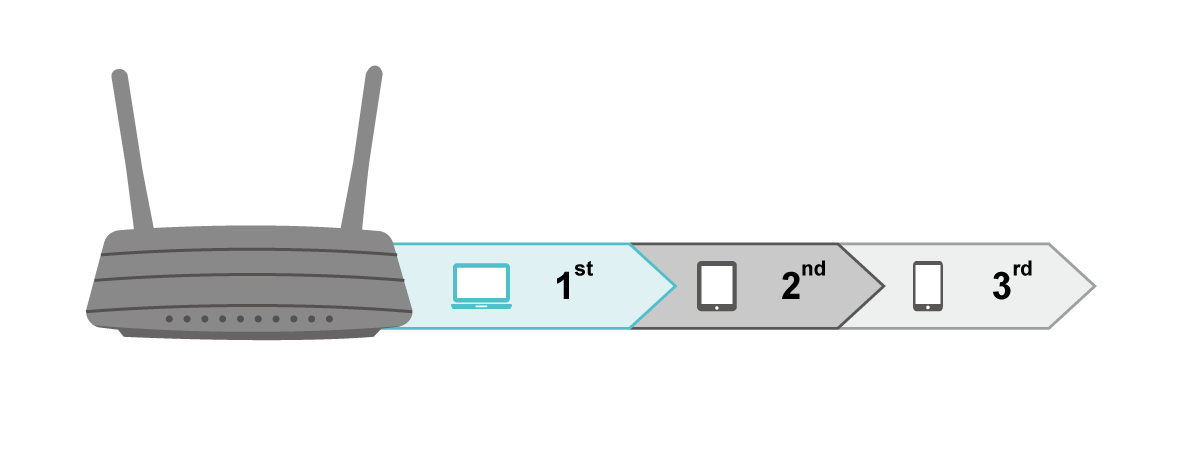
Second, clients continued to the same Wi-Fi always take different transmission rates. Many factors can affect the manual charge per unit merely in that location are two important factors that could assist you empathise it.
The first one is the wireless network specification of device (802.eleven wireless networking standards). No matter what kind of devices that y'all manage to join a wireless network, laptop, smartphone, tablet, etc., all of them accept to meet 802.xi standards, the worldwide specification for wireless networking. Since 802.11 is a set of standards with many adult amendments, electrical products released in different periods may meet unlike 802.11 standards. That ways your newly purchased cell telephone with a college 802.11 standard has a faster manual rate than a tablet from 3 years ago.
The second one is the distance between the client and the AP. Clients far away from the AP normally will have reduced operation because of the weaker Wi-Fi bespeak.
When a client communicates with an AP, information technology needs time to transmit data, and the slower the client is, the more than time information technology takes. High-speed clients would be over-encumbered causing long waiting times. This inevitably reduces the overall throughput of the entire wireless network.

With ATF enabled, the airtime would be fairly allocated to different clients, stopping slower clients from wasting time. High-speed clients would have more chances to accept reward of the network and help boost the overall network operation.
When should y'all enable Airtime Fairness?
TP-Link recommends enabling airtime fairness for the following situations:
- In that location are clients with varying Wi-Fi standards in the same wireless network: if you accept a number of legacy devices mixed with newer devices in the wireless network, it is a proficient thought to enable ATF for a amend wireless experience.
- There are clients located on the border of a Wi-Fi dead zone: clients with weak signal may consume also much airtime and cause other clients to lag. Information technology is best to enable ATF to guarantee that other clients can efficiently communicate with the AP.

Source: https://community.tp-link.com/us/home/stories/detail/203
Posted by: gilbertgratting.blogspot.com
0 Response to "Why Would A Cingular Wireless Tower Not Be Registered?"
Post a Comment